Category: <span>Quality Activities</span>
We’re proud to share Bellberry’s 2025 Impact Report – our first report bringing together key insights, data and achievements from the past year.
Our stories from 2025 highlight how we continue to support ethical research and promote best practice across the sector, while giving back to the medical research community.
This report reflects the collective efforts of the Bellberry community and our ongoing commitment to protecting research participants and strengthening research quality.
Download the full report below to learn more about our impact
When a potential new medicine is tested on humans for the first time it is a milestone. It is thoroughly tested for safety before reaching this stage.
Often, it’s tested on animals, but increasingly New Approach Methodologies (NAMs) are being used (previously known as Non-Animal Models). NAMs are non-animal or reduced-animal scientific methods used to evaluate the safety and efficacy of drugs. These alternative technologies can include in-vitro human models (such as organoids and organ-on-a-chip) and in-silico (computer-based) modelling.
Australia’s largest provider of Human Research Ethics Committee services, Bellberry, and ASCEPT (Australasian Society of Clinical and Experimental Pharmacologists & Toxicologists) have been working together to develop robust guidance for the use of NAMs.
Two workshops have been held with international and Australian experts over the last two years.
Following the last workshop, Alison Rogers spoke with three leaders in the field to find out more about this growing alternative technology to kick off the 2026 season of From Lab to Life.
Project Officer – Adelaide, Full timeWe’re seeking a Project Officer with strong auditing and governance experience to help deliver services that support compliance with ICH-GCP, NHMRC guidelines, and regulatory frameworks. You’ll lead auditing activities, develop quality resources, build relationships with research sites, and drive continuous improvement across our services.
If you’re passionate about strengthening ethical, high-quality research, we’d love to hear from you.
Last month at the Australian Academy of Health and Medical Sciences Gala Dinner in Canberra our new Bellberry-Viertel Fellow was announced!
Congratulations to Associate Professor ZongYuan 宗元 Ge 戈 of Monash University who is a medical AI specialist.
ZongYuan 宗元 Ge 戈 will use the five-year Fellowship to develop Australia’s first AI Unified Phenotype Foundation model for diagnosis, prognosis and discovery in healthcare.
Congratulations to the other two Viertel Fellows Dr Joanna Achinger-Kawecka and Dr Dustin Flanagan.
The Sylvia and Charles Viertel Charitable Foundation has awarded 70 Fellowships over 30 years and as a not-for-profit provider of Human Research Ethics Committee services, Bellberry is proud to be working with the Foundation and Equity Trustees to provide the third Fellowship.
The National Statement on Ethical Conduct in Human Research is the principal reference for research involving humans in Australia and is the guiding document for Human Research Ethics Committees. The National Statement is released by the National Health and Medical Research Council (NHMRC) and is periodically updated to stay relevant to evolving research practices, ethical understanding and community needs.
The 2025 revision, originally due to take effect on 1 October 2025, has been postponed until early 2026. However, institutions are encouraged to adopt it earlier and Bellberry will apply the changes from 1 October 2025.
The 2025 revision of the National Statement incorporates a fully revised Section 4 and consequential or minor changes to almost all other sections. The revised National Statement includes the following major thematic changes in Section 4:
- framing the need for additional consideration for individual participants or groups of participants in terms of increased risk of harm, rather than in terms of vulnerability
- emphasis on inclusion of individuals and groups frequently excluded or under-represented in research
- drawing a distinction between research with people who are at increased risk due to characteristics or circumstances, and increased risk due to research contexts
- removal of the need for research involving participants potentially at increased risk to automatically require review by a full HREC, enabling the use of alternative review processes for lower risk research with the same participants, where appropriate.
The revisions also include recognition of issues related to research with Aboriginal and Torres Strait Islander people and communities in the Preamble and Section 1 of the National Statement and a revised Chapter 4.7.
We encourage all researchers to become familiar with the updates. A summary of the changes can be found on the NHMRC website.
As Australia’s largest provider of Human Research Ethics Committee services, Bellberry places great value on understanding the experience our users have of our services. Every two years we invite our users to share their feedback through our User Satisfaction Survey. It’s part of our goal to continuously improve what we do.
Your feedback helps us celebrate what we’re doing well and highlight where we can improve.
The survey plays a vital role in strengthening our commitment to Association for the Accreditation of Human Research Protection Programs, Inc. (AAHRPP)’s quality improvement standards and ensuring we continue to deliver the highest quality of service in research ethics review.
If you are an investigator, researcher or staff member in a CRO or sponsor that uses Bellberry, we’d love to hear for you.
The survey closes on Friday 3 October 2025.

We are pleased to release the summary report from the Bellberry & ASCEPT New Approach Methodologies (NAMs) Introductory Workshop, held in Melbourne, 30 Nov 2024.
The report captures insights from regulators, ethicists, researchers, and industry leaders on how Australia can support the responsible use of NAMs to reduce reliance on animal models, improve translational outcomes, and support the transition into first-in-human and early clinical trials.
It outlines:
- Drivers for NAMs adoption
- Validation, regulatory, and ethical considerations
- Therapeutic scenarios explored to test the role of NAMs
- Key priorities for policy, funding, and collaboration
To download the full report please visit our website here
Worldwide there is growing focus on using NAMs (Non-Animal Models also known as Novel Approach Methods) in the development of therapeutics. In other words, removing animals from pre-clinical testing.
In this episode of From Lab to Life, we take you to a symposium hosted by Bellberry and ASCEPT (Australasian Society of Clinical and Experimental Pharmacologists and Toxicologists) held late in 2024.
Regulators, ethicists, researchers and industry gathered to discuss shaping a nationally coordinated approach – find out more in “All About NAMs”.

Bellberry is delighted to share details of our grant program to support participant engagement at scientific meetings.
Conference organisers can apply to Bellberry for funding to create and/or enhance participant-centric programs to enable the participant voice to be represented and heard at their meetings. The program will make a real difference with the ultimate aim of improving research by embracing participant perspectives.
For further information on the program, or to make an application please visit our website
The deadline for applications is 8 April 2025. Completed applications should be submitted by the deadline to grants@bellberry.com.au.
In 2004 Bellberry was founded as a paradigm breaker. We are an institutionally independent not-for-profit company that offers Human Research Ethics Committee services.
Today Bellberry provides ethics reviews for more than 40% of the CTN clinical trials taking place in Australia and has re-invested $12 million into the research sector.
In 2024 we celebrated 20 years of Bellberry with a focus on the difference we’ve made since we began. This culminated with Bellberry winning the national Telstra Best of Business award for Championing Health late last year. In this episode of From Lab to Life called ‘Eye on The Prize’ we hear about the impact of Bellberry from some of our valued clients and what’s ahead from our CEO Kylie Sproston.
As of the 1st of January 2025, Bellberry Fees will be updated. The fee incorporates CPI impacts and a the review and ongoing oversight of complex Multi-site clinical trial applications (i.e Tele-health clinical trials).
The fee for review schedule can be found on the Bellberry website.
The distinction between multi-centre and multi-site (also known as a satellite/decentralised site) applications is a common question at Bellberry. We will clarify these terms by providing examples, highlighting their differences, and explaining the associated fee structures.
Whether participating locations under the oversight of a Principal Investigator meet the definition of multi-centre or multi-site are considered by the Bellberry team and reviewing HREC.
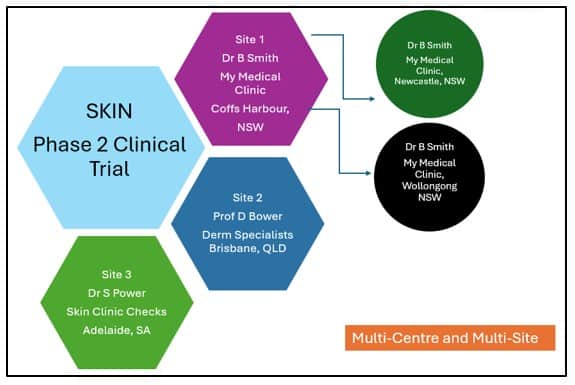
Multi-centre applications refer to research studies conducted at multiple locations, each under the oversight of a different Principal Investigator (PI). Each site conducts the study independently within the study framework, requiring distinct ethical oversight and governance processes at each participating location.
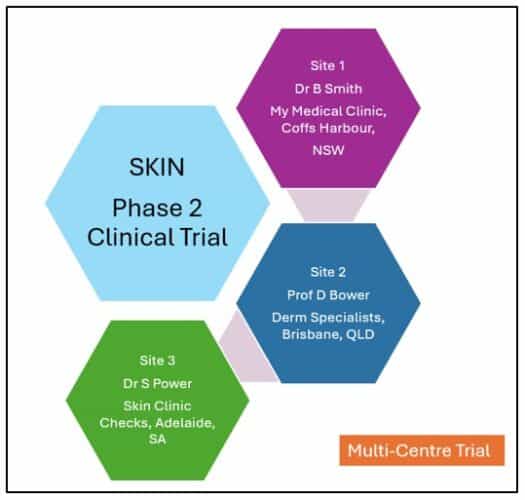
In contrast, multi-site (satellite/decentralised) applications involve research conducted across multiple locations under the oversight of a single Principal Investigator (though the study may be conducted at other multi-centre locations).
A multi-site application typically centralises the study’s management, with the PI taking responsibility for the conduct and oversight of the study at the locations affiliated with that application. For instance, in a tele-trial or decentralised model, a primary site may coordinate elements of the research activities across multiple locations while maintaining unified oversight under the same PI.
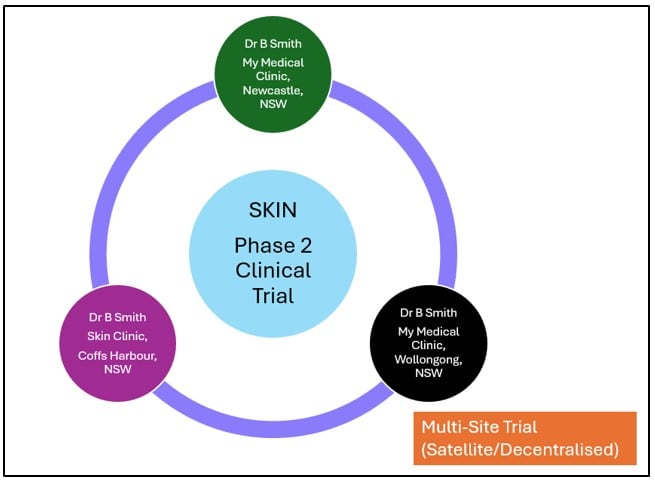
Studies can also be multi-centre and multi-site as per the image below:
Like multi-centre applications, multi-site applications require administration to ensure robust governance, consistent implementation, and compliance with regulatory and ethical standards across all participating locations. This requires additional resourcing from the HREC and will incur an additional fee from 1 January 2025.
Please note that this will be prospectively introduced and will not impact existing applications, unless an amendment to include a multi-site location is submitted to the HREC for review. Non-clinical trials, such as registries or vendor sites will not incur a fee for multi-site locations.
If you have any queries, please email bellberry@bellberry.com.au
We are delighted to share that Bellberry won the National Telstra Best of Business award in the Championing Health category in Melbourne last night, recognising our impact in the medical research sector.
Initially 22,000 businesses were nominated, with seven chosen as national winners in their categories. We’re thrilled to be one of those seven.
Bellberry CEO Kylie Sproston reflected on the significance of this milestone:
This is great recognition, but it is also about the incredible quality of work that is undertaken more broadly in the Australian research sector. The sector has grown continuously over the last 20 years and was valued at $1.6 billion dollars in 2022.
Bellberry has oversight of more than 40% of Australia’s clinical trials with two thirds of those trials coming from overseas. This is due to the calibre of our clinicians and the reputation of our research ecosystem.
We have achieved this win thanks to the support of all our partners and collaborators.
The medical breakthroughs of the future are only possible because of the volunteers participating in clinical trials today. We couldn’t do our work without them.
Bellberry exists to protect the welfare of research participants and in accepting this award I want to pay tribute to their contribution.
This is the 20th year that Bellberry has been operating, making this award and the recognition of our role in advancing health innovation globally, even more remarkable.
In her acceptance speech last night Kylie celebrated “the strength and reputation of the Australian medical sector and the amazing Bellberry community including our staff, HREC members, and our Board who are passionate about making a difference”.
In ‘The Balancing Act’ we meet Professor Andrew Wilson AO, the recently retired Chair of the PBAC.
Andrew is a former Chief Medical Officer of Victoria and has spent his career trying to get the best possible outcomes in public health through our state and federal governments.
For someone focused on evidence based research, engaging in the political system can be a huge challenge.

The Operations Update for October contains useful information including some important updates to the eProtocol HREC application form and the Amendment form. Please read the update for further information:
We’re delighted to announce that Dr Marcel Doerflinger of the Walter and Eliza Hall Institute of Medical Research (WEHI), was announced as the 2024 Bellberry-Viertel Fellow at the Viertel Symposium last week.
The Bellberry-Viertel Fellowship supports a Senior Medical Research Fellow to receive $1.375 million over five years to support their research. Dr Doerflinger’s work focuses on revolutionising treatment for lung disease, in particular Tuberculosis (TB). TB remains the deadliest infectious disease worldwide, killing one person every 20 seconds, with drug-resistant strains posing a significant public health threat.
Current TB vaccines offer incomplete protection, and the lengthy, toxic antibiotic treatments required often lead to lead to poor compliance, further fuelling the rise of antimicrobial resistance (AMR). Without new, innovative treatments, millions of people could die each year from AMR-related infections. Marcel’s research seeks to address this challenge by developing RNA-based therapies that manipulate the body’s own defence mechanisms—specifically, a process known as programmed cell death. Rather than directly targeting bacteria with antibiotics, which can lead to resistance, these therapies focus on enhancing the body’s immune response. Marcel has recently been appointed as a Lab Head at WEHI (Walter and Eliza Hall Institute of Medical Research) overseeing the PC3 facility within the Infectious Diseases and Immune Defence Division. His aim is to leverage and expand his foundational work towards novel therapies for high impact infectious diseases.
Congratulations to the two Viertel Senior Medical Research fellowship winners Dr Rhea Longley of WEHI and Dr Luke Isbel of the University of Adelaide and thanks to the Viertel Foundation’s Medical Advisory Board, the Viertel Trustees and Equity Trustees.
Read the Equity Trustees Press Release